Thursday, 10 November 2016

9 best places to visit in India during December

Courtesy:http://travel.india.com/articles/9-best-places-to-visit-in-india-during-december/#

1. Mount Abu

Photograph courtesy: Sabomoni/Creative Commons

What to do: Attend the Mt Abu Winter Festival on snuggle under a blanket… with a book or your sweetheart!
Rajasthan’s only hill station is a perfect getaway from the deserts of the state. Known for its Dilwara Jain Temples, Achalgarh Fort and Nakki Lake, Mount Abu is a nice place to enjoy yourself on a winter vacation. The Mt Abu Winter Festival is around the corner for those looking for a visually and aesthetically appealing cultural exchange.

2. Diu

Photograph courtesy: Inoxia Fotografia/Creative Commons

What to do: Participate in Asia’s longest beach festival and to soak in a bit of the Portuguese culture in a place that is NOT Goa.
Diu is one of the most underrated union territories of India. There are several forts, churches and chapels and beaches that you can visit. Since it’s a destination, not explored by many, it calls out to those willing to enjoy a weekend or two by themselves. However, there is a pretty amazing-crazy side of Diu that you can catch a glimpse of only for a few months. The Festa De Diu, Asia’s Longest Beach Festival is from December 1, 22015 to February 15, 2016. You can spend a day, a week or even a month or two here!

3. Goa

Photograph courtesy: Juha Riisanen

What to do: Burn the dance floor at India’s best parties, shop your heart out at the many flea markets and pray for your soul during the feast of St Francis Xavier
Goa is indeed the most famous and loved party destination of India. It welcomes you with open arms and magnificent sunny beach-fronts all round the year. But December is special for various reasons. From night bazaars and the flea markets to the feast of St Francis Xavier and the loudest EDM party, Sunburn or Supersonic, Goa has exactly everything to offer, you could ask for. Right from Christmas, all the way to New Years, Goa is THE venue for a month long party.

4. Chennai

Photograph courtesy: Sunciti Sundaram/Creative Commons

What to do: Soak in some culture at the Madras Music Season, drive to Pondicherry or better still to Mahabalipuram for the Mamallapuram Indian Dance Festival
They say that Chennai is has two seasons, eight months of the month it’s hot and the rest four, it’s even hotter! The truth is, unlike most assumptions, December is Chennai is pleasant and it gets as close to being cool as possible. Weather-wise, it is literally the only apt time of the year you can vacation at Chennai. Not to forget, the Madras Music Season (December 15, 2015 to January 1, 2016) will give you a taste of the culture of Chennai. If not, you can drive through the East Coast Road all the way to Pondicherry or stop over at Mahabalipuram to enjoy the Mamallapuram Indian Dance Festival (December 21, 2015 to January 21, 2016)

5. Great Rann of Kutch


What to do: Attend the Rann Utsav, obviously!
The Great Rann of Kutch along with the Little Rann of Kutch is a salt desert marsh in the Thar Desert that ends at north Gujarat. Though summers are extremely hot, winter temperatures fall down to approximately 0°C. The Gujarat Tourism Development Cell organizes an annual two month long festival, Rann Utsav. This year, the festival will be held from December 23, 2015 to February 29, 2016. Welcome the new year at the white desert with colorful people of Kutch.

6. Santiniketan


What to do: Attend the Poush Mela, attend the Bishnupur festival
West Bengal proudly boasts of its university town and celebrates its foundation in the month Poush, as Poush Mela which is a must-visit. If you think there isn’t much for you to do in Santiniketan, you can always drive off the near by villages to cuddle up during the winters. Another option is, particularly for shopaholics, to visit Bishnupur. The Bishnupur festival will slowly and gradually burn a hole in your pocket, all thanks to the irresistible handicrafts and silk and terracotta products.

7. Udaipur


Lake Pichola

What to do: Shopping at the Shilpgram Arts and Crafts Festival, wander in the by lanes of Udaipur
Udaipur is home to Lake Pichola and the Fateh Sagar Lake along with its magnificent City Palace, Monsoon palace, Lake Palace and Jag Mandir that lure travelers to visit this royal city. Seven km away is Shilpgram, a government set up village to promote artisans. The articulate and intricate work by these local artisans will leave you spell bound. This month, the village will celebrate the Shilpgram Arts and Crafts Festival, that you should totally be a part of.

8. Gulmarg

Photograph courtesy: Batsmidt

What to do: Pack warm and go skiing
With the wedding season in full swing, this breathtaking honeymoon destination is going to be flooded by hundreds newly weds. However, Gulmarg has sufficient space for you as well, if you’re looking for some adventure and memories from a perfect skiing trip to take back home. Mind you, the temperature is estimated to be anything between -2ºC to 9ºC. So pack up all those winter clothes. you’re most definitely going to need them!

9. Gangtok

Photograph courtesy: Anthony Vance/Creative Common

What to do: Celebrate the Sikkimese New Year, eat momos… lots of them!
Along with the New Year, December also marks the Sikkimese New Year that is celebrated with great all around India’s smallest state. The zest and the enthusiasm of the Bhutia and Lepcha community is something you must not miss! The Sikkimese are known to be very hospitable, momos here are die for and the cultural extravaganza will ensure a trip you will not forget.
Courtesy:http://travel.india.com/articles/9-best-places-to-visit-in-india-during-december/#


15 Best Places for Winter Holidays in North India

Courtesy:https://www.tourmyindia.com/blog/25-best-places-for-winter-holidays-in-north-india/

1. New Delhi

red-fort-delhi

The capital city of India, New Delhi, with the fusion of age old history and varied cultural diorama, is one of the bustling tourist destinations in North India during the winter season. The city with its quaint charm that is said to be dating back to the Pandava era is one of the significant historical cities in India. The city is home to several ancient monuments, forts and churches that delineate the chapters of Indian history. Amongst them the Purana Quilla, Qutub Minar, Jantar Mantar, Red Fort, Jama Masjid and Humayun’s Tomb holds special tourists’ interest. The ruins of Tughlaquabad Fort, Lotus Temple and Lodhi Garden and its monuments are some other heritage attractions in New Delhi. The India Gate, which is close to the Parliament and Rashtrapati Bhavan, is yet another popular tourist attractions that stands as a memorial to all the Indian soldiers who lost their lives during the Indian Freedom Movement, Indo-Pak Wars and Sino-Indo Wars. Rajghat, which is yet another memorial, holds a national significance and attracts tourists from all over the world.
Being in the city you can’t escape from the quaint charm of Chandni Chowk and the colonial ambiance of Connaught Place. Chandni Chowk is one of the oldest and congested areas of the city that is noted for its multiple arrays of shops dealing in jewellery, antiques, garments and street food, ‘Parathe Wali Gali’ is a must visit place when you are in Chandni Chowk. On the other hand Connaught Place, which acts as a bridge between Old Delhi and New Delhi, is a popular hangout in the city with numerous multi-cuisine restaurants, pubs, shopping arcades and hotels.
The Akshardham Temple, which is the largest Hindu Temple in the world, exhibits a detailed picture of Indian culture and religion… thus making it another prominent tourist attraction in New Delhi. Don’t miss out the light and sound show. If you are travelling to New Delhi at the time of Republic Day then you must catch a glimpse of the parade in front of the Red Fort. Shopaholics have a whole lot of options. S.N. Market, Lajpat Nagar, Janpath, Sadar Bazar and Palika Bazar are some of the notable shopping areas in the city where arrays of shops from garments to handicrafts and antiques to electronic goods can be found.
Temperature during winter: 3°C to 22°C

2. Agra

agra
Home to one of the seven wonders of the world, the Taj Mahal, which is a marble monument built by Shah Jahan and often dubbed as a ‘symbol of love’, the medieval city of Agra is yet another good pick from the bucket of destinations to visit in North India during the winter. Agra dilates an eminent chapter of the Golden Era of the Mughal Empire. The city hosts several other historical ramparts including the Agra Fort and other monuments and palaces. It is also noted for its traditional culture, architecture, marble crafts, leather products and cuisine. During the winter Agra is packed with tourists from all over the world but the marvelous sight of the Taj Mahalonce you get hold of leaves you in a state of solitude… no matter who so ever knocks you from behind. Approximately an hour’s drive from Agra, Fatehpur Sikri, which is famed for its Buland Darwaza, is one of the UNESCO World Heritage Sites in India, and is a must visit place for travellers having an interest in Indian medieval history. Further, the Bharatpur Bird Sanctuary makes for a refreshing getaway from Agra.
Temperature during winter: 7°C to 25°C

3. Jaipur

jaipur-amber-fort
The only planned city of its time, Jaipur the capital city of royal Rajasthan still beats in its fairy tale palaces and rugged fortresses perched on hills. Today it is a blend of tradition and modernity but the colour pink is still associated with hospitality in Jaipur. Being of historical importance, the city is one of the most popular tourist destinations in North India during the winter. It is a city where a traveller can participate in a lot of activities like heritage tour, shopping traditional items and jewelleries, elephant safari apart from trying out Maharaja Thali. The City Palace, Hawa Mahal, Jantar Mantar, Lake Palace and Amber Fort are the major heritage sites in Jaipur. In the outskirts… the Nahargarh Fort and Jaigarh Fort are the two notable heritage sites. On the other hand, the city hosts several Hindu and Jain temples; of them the Birla Mandir, Narayan Temple, Galtaji, Choolgiri Temple, and Govind Devji Temple are the notable ones. Ram Niwas Bagh, Dolls Museum, B.M. Birla Planetarium and Ghat Ki Guni are some other tourist spots in Jaipur. Well, don’t miss out the light and sound show at Kesar Kyari in Amber Fort. It is held every evening.
Temperature during winter: 7°C to 25°C

4.Jaisalmer

jaisalmer
The remote fort city of Jaisalmer, which is located in the midst of the Thar Desert in the incredible state of Rajasthan, is yet another popular winter getaway in India. It attracts all travellers including honeymoon couples, and other leisure travellers. The city is noted for several architectural buildings belonging to former rulers. The Jaisalmer Fort, which is also known as ‘Sonar Quilla’, housing several havelis and Jain temples, is one of the beautiful examples of craftsmanship exhibiting the rich Rajasthani style of architecture with intrinsically designed walls, carved windows and facades. The Nathmalji-Ki-Haveli, Patwon-Ki-Haveli and Salim Singh-Ki Haveli are the major tourist sites that elaborate the intricate architecture and sheer craftsmanship. The Gadisar Lake with numerous beautiful shrines, and Bada Bagh housing several cenotaphs are some other tourist sites in Jaisalmer. In the outskirts of Jaisalmer City, the ruins of Kuldhara village, Barna village, Khuri Desert, Moolsagar Palace and Ram Mandir are must visit places that leave travellers spell bound. On the other hand… how can you escape from Jaisalmer without a camel safari in the SAM Dunes? That’s the only way to explore the vast stretch of the Thar Desert. The best time to visit the SAM Dunes is during the Jaisalmer Desert Festival, which is held in the month of February. It is the best way to get acquainted with Rajasthani folk culture.
Temperature during winter: 3°C to 25°C

5. Udaipur

udaipur
One of the historic cities in India that is famous internationally as the most romantic destination in the world, partly because of the influence of the Lake Palace Hotel located in the middle of the placid water of Lake Pichola… Udaipur during the winter season pulls in travellers from all over the world. Like any other cities in Rajasthan, Udaipur also comes with its own legends and much of its history is clearly visible from the picture perfect gallery hosting palaces, gates, temples and quaint alleys. Each and every turn and bricks are preserved with heroism, valour and chivalry. Yet the city turns out to be one of the honeymoon destinations in India during the winter. The major attractions are the Lake Palace, Lake Pichola, City Palace, Fateh Sagar and Monsoon Palace. Some other attractions in Udaipur are Gulab Bagh, Ahar, Pratap Memorial, Saheliyon Ki Bari, Jagdish Temple and Bhartiya Lok Kala Mandir. Close to Udaipur, Mount Abu is the only hill station in Rajasthan and is worth a visit during the winter. Other excursions on your Udaipur tour can be Kumbhalgarh, which is approximately 84 kilometers away, and Ranakpur, which is approximately 90 kilometers away.
Temperature during winter: 7°C to 25°C

From the Hills to Mind Haven

6. Manali

manali
That’s my favourite pick any time of the year and during the winter when you catch the glimpse of snowfall early in the morning… holding a cup of hot coffee in your hand, your partner being cozy with you at the same time and the stunning views of far-fetched snow capped mountains blazing the intimacy… Ah! Nature here herself showers romanticism. I feel like rolling over the bed once again and pouring some more lovely moments into my winter trip to Manali. “WINK” but now it’s time to grab nature at her best. Manali is one of the popular hill stations in India where tranquility dwells even in the midst of tourist crowd throughout the year. Nature here hosts an amazing alpine forest of Pine and Deodar trees dotted with several fruit orchards and cattle farms. An hour’s drive from Manali to Solang Valley, which during the winter season turns out to be one of the popular ski resorts in India, one can here exploit the nature with several adventure activities like skiing, zorbing and paragliding. Well… the temperature over here throughout the winter remains freezing and hence it is recommended to carry proper woolen garments if you are planning to go for paragliding in Solang.
Manali is also a gateway to several trekking destinations in Himachal Pradesh. During the winter season you can go for some short treks in Manali like the Bhrigu Lake trek and Beas Kund trek. Other popular treks around Manali are the Malana Valley and Chandra Tal trek, but during winter these treks are difficult to access. Rohtang Pass, which is at an altitude of approximately 4,000 meters, is a popular tourist destination in Manali being the highest point on the Manali-Keylong road. Although access to Rohtang Pass during the months of December, January and February becomes impossible due to heavy snowfall, yet some crazy trekkers do make it to the point. Are you one of them?
Besides its breathtaking natural beauty, Manali is also notable for housing a rich and indigenous Indo-Tibetan culture. The Gadhan Thehchoking Gompa and Nyingamapa Gompa are the two popular Buddhist pilgrimage sites that pull in several tourists from all over the world. The quaint ambience of Vashisht village, which is approximately 3 kilometers away from Manali, is also worth a visit on your winter trip to Manali. The village is far-famed for hosting several hot springs and stone houses with beautiful carvings. Apart from all… the cultural clamour can be witnessed thoroughly when you visit Old Manali. The Hadimba Temple and Manu Maharishi Temple are the notable attractions here. Some other beautiful places to visit around Manali are Katrain which is popular for its apple orchards and trot hatcheries; the temple town of Naggar; and Manikaran, which is an important Hinduand Sikh pilgrimage site.
Temperature during winter: -2°C to 15°C

7. Dalhousie

dalhousie
The name itself throws a distinct colonial charm. Named after the 19th century British Governor General Lord Dalhousie, the scenic hill station in Himachal Pradesh, Dalhousie houses some of the most beautiful churches of North India. The St. Patrick’s Church, St. Francis Church, and St. Andrew’s Church are the most notable ones having rich architectural work of their own with stone carvings, glass and wooden structures. Besides the colonial diorama, the town’s varying altitude spreading out over the Kathlog, Potreys, Tehra, Bakrota and Balun hills is dramatically set with a dense grove of pines, deodars, oaks and rhododendrons… which almost remains covered in snow during the winter. Yes! Snowfall in Dalhousie during the winter season is the major attraction. It is the best time to frame the panorama of the breathtaking countryside from Panchpula, Bakrota Hills and Dainkund. Approximately 10 kilometers from Dalhousie, Kalatope is yet another scenic spot that also houses a wildlife sanctuary. Close to Kalatope, Ahla village is one of the notable pilgrimage sites in and around Dalhousie. Built in the 10th century, Laxmi Narayan Temple is one of the finest specimens of ancient architecture in Dalhousie. Talking about antiques… you must pay a visit to Satdhara, which is a stupa dating back to the Murya and Sunga period. Dakshina Murti, Shivkul and Norwood Paramdham are some other cultural hubs in and around Dalhousie.
Temperature during winter: 1°C to 10°C

8.Kasol

Kasol
One of the least tapped hill stations in Himachal Pradesh that is nestled in the luxuriant greens of the thick pines in Himachal’s Parvati Valley, Kasol during the winter season truly offers a quiet weekend getaway. The small town on the bank of River Parvati with patches of small villages in the midst of dense pinewood is a hideout ideal for an impromptu nature holiday in the Parvati Valley. Further, the trek to Malana Village, which is one of the strenuous treks in Himachal Pradesh, is a good option for an adventure trip during the winter. A visit to the nearby Tosh village allows you to get acquainted with the Himachali folk culture where people are extremely hospitable. Moreover, lazing around in Kasol is just not one option for leisure travellers. Kasol is well known for trout fishing and hence travellers dreaming of fishing and angling holiday in the Indian Himalayan region may whizz to Kasol in the winter months.
Temperature during winter: 5°C to 20°C

9.Kasauli, Himachal Pradesh

kasauli
Amid the quaint colonial ambiance, Kasauli unwraps rejuvenating elements of nature with the panorama of sprawling plains of Punjab and Haryana. The moment might drop your jaws when you catch sight of the blazing carpet of light as darkness falls. Kasauli during the winter season makes a cool escape from the city dust to the refreshing atmosphere that is cuddled with thick forest of pine, oak, and chestnut trees. Its colonial ambiance is reinforced by stretches of cobbled roads, shops, houses with charming facades and scores of neat little gardens and orchards. The ‘Monkey Point’ is one of the must visit places in Kasauli, which is an important pilgrimage site. Nonetheless, the Baba Balak nath Temple and Sai Baba Mandir are also two other religious sites in Kasauli. Other attractions in Kasauli include the St. Patrick’s Catholic Church that was built in 1847 AND Sunny Side, which is the oldest cottage in Kasauli, built in 1848.
Temperature during winter: 3°C to 15°C

Dharamshala

dharamshala
Extolled as one of the picturesque hill stations in India that lies on the spur of the Dhauladhar Range and dotted with thick grove of Oak and Conifer trees, Dharamshala is no doubt a great escape during the winter season. It’s not just about the distinct culture of the Indo-Tibetans that has helped Dharamshala gain fame internationally as “The Little Lhasa in India”, being the seat of His Holiness The Dalai Lama… BUT the traditional fusion of several tribal communities makes Dharamshala one of the important cultural hubs in Himachal Pradesh. A glimpse of it can easily be witnessed when you step into the Kotwali Bazar, which is a good shopping area, and McLeod Ganj, which has arrays of shops selling Tibetan handicrafts. During the winter season the international cricket stadium overlooking the mighty Dhauladhar mountains is one of the spectacular sights that remain covered with thick patches of snow. On the other hand, the Namgyal Monastery is one of the major tourist attractions in Dharamshala. Some other attractions in Dharamshala include the Kangra Art Museum, War Memorial, Kunal Pathri Temple, St. John’s Church, Aganjar Mahadev Temple and Kangra Chamunda Devi Temple.
Temperature during winter: 1°C to 12°C

11. Shimla

shimla
Even though it remains one of the bustling hill stations in India throughout the year, Shimla during the winter season turns out to be a fantasy world. The nature herself boasts off a scenic spectacle with layers of snow bedded over the thick alpine forest AND the panorama from the Ridge of snow capped mountain ranges engulfed in the beauty of the nature is worth a capture. It is the best time, especially in the months of December and January, to go for a forest trail that runs towards the villages of Kamina and Pabo. If you are lucky some bird species can also be sighted. A short trek to Tattapani is also recommended as one of the adventure activities in Shimla during the winter season. Further, if you are looking for some more adventure then just whizz your wheels an hour snaking through the mountains to Kufri, which lies at an altitude of 2,622 meters and is one of the notable skiing destinations in the Indian Himalayan region with varying slopes. Just when you find the temperature dipping and you run out of warm garments, check out some quality woolens, jackets and shawls arraying down the Mall, which is one of the longest stretches of pedestrian shopping in the world. It also has arrays of hops dealing in traditional handicrafts, miniature paintings, jewellery, metalwares, rugs and carpets. Close to the Mall is the Himachal State Museum, which is one of the finest examples of craftsmanship from the colonial era. It exhibits a huge collection of coins, photographs and handicrafts. The Gaiety Heritage Cultural Complex, which is another colonial architecture built in a Gothic Victorian Style; Shimla State Museum that was built in 1974; and George Castle are some of the prominent tourist attractions in Shimla. The temperature might get very freezing during the winter, BUT one must step into the Christ Church that was built by the British in 1857 in the Neo-Gothic style of architecture and is one of the long lasting legacies of the British Raj. On the other hand, the Jakhoo Temple, which is an ancient temple dedicated to Lord Hanuman, is one of the important Hindu pilgrimage sites in Shimla AND one can even get hold of beautiful views of the Shivalik mountains and the nearby town of Sanjuli. Other popular religious sites are Tara Devi Temple and Sankat Mochan. A visit to Naldhera which hosts India’s oldest nine hole golf course and Chail which holds the unique distinction of being the highest cricket pitch in the world… completes your tour to Shimla during the winter season.
Temperature during winter: 1°C to 12°C

12. Mussoorie

mussoorie
With green rifts of the Doon Valley at an altitude of 1,880 m, Mussoorie takes one back to the colonial past through its tralatitious appetizing cuisine and magnificent architectures. With abounding trekker-friendly area, stunning chatoyant natural panorama and glistering lakes, Mussoorie is also dotted with slushing waterfalls and shrubby forest. Kempty falls on the way to New Tehri is the most popular tourist destination. Among the several other tourist spots, Sir George Everest House is often visited by tourists.
Temperature during winter: 5°C to 20°C

13. Nainital

nainital
Located in the Kumaon region, Nainital, popularly known as the Lake District in India, is the weekend gateway for nigh domestic tourists and a beguiling sashay for foreign tourists round the year. At a height of 1,938 m, Naini Lake, holding a perpetual Hindu myth, is a summer retreat in the heart of Nainital. A pony ride or a very short trek up to the Naina peak, en route through shrubby forests, at an elevation of 2,615 m, which is the highest point in Nainital, offers a panoramic view of distant snow-clad peaks like Nanda Devi, Trishul and Nanda Kot. These peaks can also be clear-sighted from Snow View Point. Orienting towards a quest for more natural virtue Nainital is bonded with hermit destinations like Mukteshwar, offering an unhindered view of majestic Himalayan range; Bhimtal Lake, which is larger than Naini Lake; Sat Tal, a cluster of seven small interconnected lakes in the mystic oak forest; Khurpa Tal, a trowel lake; Naukuchia Tal, a nine-cornered lake; Kilbury, a weekend picnic spot popular for its flora and fauna and Pangot, a thick forest of oak, bamboo and deodar.
Temperature during winter: 2°C to 15°C

14. Ranikhet

ranikhet
The “Queen’s Meadow” with lush green conifer forests, hearty ambience, placid surroundings, emerald green valleys and ancient temples is footsure making it an year-round destination for tourists. Ranikhet, the tiny hill paradise, is just a couple of hours drive from Nainital.
Temperature during winter: 7°C to 20°C

15. Kausani

kasauli
Yet another spectacular hideout in the hills of Garhwal, Kausani during the winter elaborates a striking environment with the Someshwar Valley on one side and Katyuri Valley on the other. The landscape that is dotted with dense pine trees and shadowed by the scenic spectacle of Himalayan peaks like Trishul, Nanda Devi and Panchchuli… can’t be compared with any other hill stations in the Garhwal region. The quaint hill station with its picture perfect ambiance has been a favourite place for several notable personalities like Mahatma Gandhi and Sumitranandan Pant. The Anashakti Ashram, where Gandhi spent some days and wrote his commentary of Anashakti yog, is one of the major attractions in Kausani. The ancient Baijnath Temple, which dates back to the 12th century, and the Someshwar Temple, which was crafted by the Chand Dynasty, are the major pilgrimage sites around Kausani and are considered historically significant. The Rudrahari Mahadev Temple on the way to the Adi-Kailash trek is yet another spiritual site near Kausani. During the winter, the Kausani Tea Estate turns into a must visit place. It is spread over an area of 208 hectares and stretches from an elevation of 1,200 meters to 1,800 meters.
Temperature during winter: 2°C to 15°C
Courtesy:https://www.tourmyindia.com/blog/25-best-places-for-winter-holidays-in-north-india/


Thursday, 27 October 2016

BRICK TEMPLE TOWNS OF BANKURA – PART I : BISHNUPUR

Courtesy:https://amitabhagupta.wordpress.com/2012/08/05/brick-temple-towns-of-bankura-part-i-bishnupur/
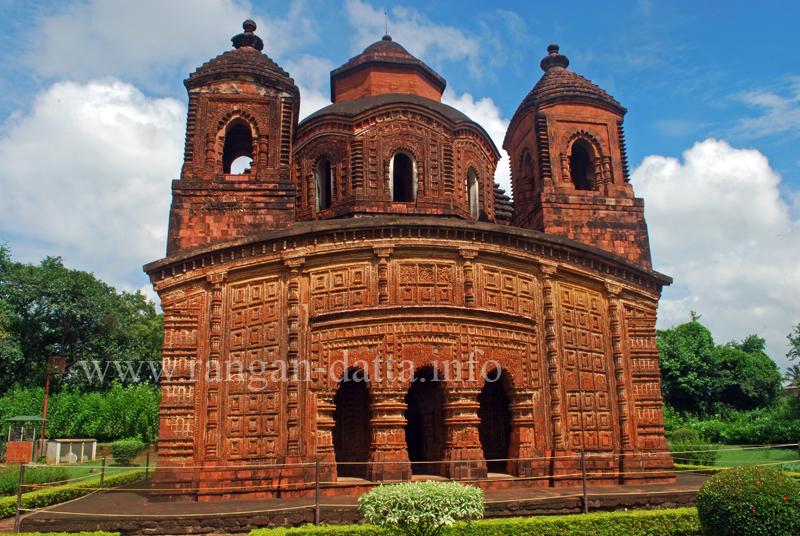
Image result for Bishnupur Temples, Bankura

Around 695 AD, one Khastriya King during his travel was forced to stay in a Brahmin’s house residing at a village named Lau due to the ill health of his expecting wife. This village was located near Kotulpur of today’s Bankura district of West Bengal. The King‘s wife delivered a child and died. The remorseful king surrendered his infant child to the Brahmin as his guardian and left the place. The child grew up to excel on every spheres of life and went to become the first Malla King – Adi Malla and established the Malla Kingdom. After 300 years the kingdom was shifted by one of his descendents. The new Kingdom’s name was Bishnupur. It is said that this descendant named Jagat Malla was inspired by divine intervention to build up a temple of Goddess Mrinmoyee at Bishnupur and shift the kingdom there.
King Bir Hambhir
Bishnupur shot into fame during the rule of Malla King – Bir Hambhir the 49th Malla King (1586-1621). He was friendly with Mughals and took their side in their battle with Afghans. However after his interaction with Vaishnav guru Srinivas Acharya, Bir Hambir become his disciple. This incident resulted in a revolutionary change in Bishnupur and the Malla Kingdom became a hub of Baishnab culture. After a tour of Vrindavan with his guru, the King built started building up Baishnab structures and temples which was followed by his descendants which evidently turned Bishnupur into the most talked about temple town of Bengal.
West Bengal Tourist Lodge, Bishnupur
Boarding the Howrah Purulia Express we reached Bishnupur around eight o’clock in the night. A cycle rickshaw journey of 20 minutes took us to our night’s stay at the West Bengal Tourist Lodge. Settling up for the night in our comfortable stay, we rose early next morning to start our tour of Bishnupur. After a refreshing bath followed by a sumptuous breakfast at 07:30 in the morning, we walked to reach our first stop – The Rasmancha. It is here you have to purchase tickets for entering Rasmancha, Jor Banglo (Kesto Rai) Temple and Shyam Rai Temple. Most of the prominent temples in Bishnupur are undertaken by the ASI (Archeological Survey of India).
Ras Mancha , Bishnupur
Name engraved on walls by Cattle Class Tourists
The Rasmancha
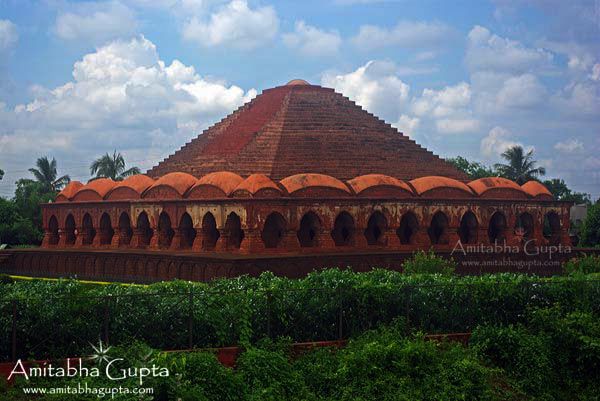
Established in 1600 AD by the King Hambhir, the Rasmancha was used to display all the local idols in public during the Ras Festival. The Rasmancha stands on a raised laterite plinth with a Pyramidal Superstructure. It is thrilling to walk though its circumbulatory galleries having several arches through which the sun creates a mysterious light and shade effect. It is a unique and unparallel piece of architecture. However, it is painful to see ignorant and cattle class tourists having engraved the interior bricks with their names in crudest possible way.
One of the circumbulatory galleries of Rasmancha
Small Gate to the fort
Murcha Hill
Murcha Hill
Two Gateways and Stone Chariot
From the Rasmancha we took a brisk walk. Passing through narrow lanes of Bishnupur we finally came to an open space and encountered a stone gate on the middle of the road. This is known the Small Gateway to the fort. There is a small mound nearby besides a water body locally known as Murcha Hill (!) where canon is fired during Durgapuja. To the North West of this entrance there is small stone Chariot made of laterite stone. Like the Rasmancha this 17th century build structure is one of its kinds.
Stone Chariot
Stone Chariot
Large Gate of the fort
The next structure was an immense gate which was once entrance to the Bishnupur Royal Kingdom. Not only it is an entrance but it has a huge terrace which was perhaps to keep track of enemy soldiers. We were told that there is a secret chamber in its top floor from where soldiers could perform surprise attack on the enemy.
Two Ek Ratna Temple
As we entered through this gate we saw one Ek Ratna (One Pinnacled) temple on the far left side surrounded by a big boundary. This is the Laljiu temple built in 1658 by Malla King Bir Singha. Surmounted by a single Shikhara, this temple has ornamental stucco decoration on low relief carvings on its front wall.

Laljiu Temple, Bishnupur
Unique Gateway to Radheshyam Temple
Retracing back we encountered another interesting temple surrounded by a boundary again falling on our left. Perhaps with the most interesting temple gateway at Bishnupur, this is the Ek ratna Radheshyama Temple. Built in 1758 by the Malla king Chaitanya Singh, the triple arched gateway has two domes like structure with open windows on it. Most probably Shehnai used to be played here in old days.
Radheshyam Temple With Tulsi Mancha
The temple has an unique shaped Ratna (Pinnacle) on its top. There is a small Tulsimancha inside. Among the various artworks on its wall do not miss Vishnu in Anantashayan posture. It may be worth mentioning that all of the idols of deities belonging to several dilapidated temples are kept here and are worshiped together.
Bishnu In Anantashayan Posture, Radheshyam Temple
Beyond Radheshyam temple there is a small mound. On its other side there is a water body popularly known as Shyam Bandh. Bandh implies water tanks in Bengali. The Malla Kings had made seven Bandhs to relive people of water scarcity during the summer.
Mrinmoyee Temple & Bishnupur Fort
Mrinmoyee Temple - The first temple of Bishnupur
Mrinmoyee Temple – The first temple of Bishnupur
Just opposite to Radheshyam temple is the small and fresh painted single floor Mrinmoyee Temple. This is the oldest temple of Bishnupur. Regular worship is done here, especially during Durga Puja. Beyond the temple there is a pond. On its banks lie the ruins of Bishnupur Royal Palace/Fort. You can see the dome shaped towers from a distance. We took a tour inside the ruins but it is not advisable to venture inside. The route is full of undergrowths and a probable nesting place of snakes.
Ruins of Bishnupur Fort
Kesto Rai alias Jor Bangla Temple, Bishnupur
The Jor Bangla alias Kesto Rai Temple
Retracing back from the fort and crossing the Radheshyam temple, we went to see one of the star attractions of Bishnupur – The Jor Bangla alias Kesto Rai Temple. Built in 1655 by Malla King Raghunath Singh, this temple is known as Jor Bangla because it has two Ek-bangla or Do Chala structures (Roof with Double sided curved thatch) conjoined together, one acting as a porch, and the other as a shrine. ‘Ek’ indicates one and ‘Jor’ signifies double in Bengali. We had to show our tickets here to get entry.
Terracotta decorations on walls of Kesto Rai
Frankly speaking thirty minutes or one hour is actually a very short time for devoting time to this temple. To see all the sculptures on its wall in details, the minimum time should be at least one day. Still try not missing architecture which shows events with multiple scenes from Ramayana and Mahabharata. Examples are of King Dasarath killing Sindhumuni’s Son, Marriage of Ram, Saga of Laxman & Surpanakha, Krishna’s childhood activities. Single scene events include renunciation of arms by Bhisma, Bhishma lying on a bed of arrows (Sharashajja), Parvati feeding Ganesh & Kartika and Portugese Warships.
Following are interesting panels from the walls of Kesto Rai temple, which I have included in my blog.
 Arjuna using arrow of Rain God ( Parjanyastra) to generate water from earth for a thirsty Bhisma in bed of arrows (Sharashajja)
Arjuna using arrow of Rain God ( Parjanyastra) to generate water from earth for a thirsty Bhisma in bed of arrows (Sharashajja)
Portuguese warship carrying soldiers with firearms
Hanuman Killing Multi headed Ahiraban ( Central Panel)
King Dasarath with dead body of Andha Muni's ( Blnd Sage) Son
King Dasarath with dead body of Andha Muni’s ( Blnd Sage) Son
Ram attacking a flying Taraka Rakkhashi (Demoness)
Renunciationof arms by Bhisma as Arjuna with Shikhandi shoots at him
Renunciation of arms by Bhisma as Arjuna with Shikhandi shoots at him
Some dilapidated structures
The dilapidated Mahaprabhu Temple
From Jor Banglo it is a 15 minutes’ walk on in to the Pancha Ratna (Five Pinnacled) Shyam Rai Temple passing by two deul shaped deserted temples (Jugol Kishor Krishna Balaram Temple) on your right and a severally dilapidated temple on your left. The later known as Mahaprabhu Temple is identical to the Kesto Rai temple, but unfortunately now totally in ruins. Walking further down on the road we turned right to go into a rather picturesque lane. Just at the entrance of this lane on the opposite side there is a sinister looking square shaped deserted structure, locally known as Gumghar(Torture chamber).
Jugol Kishor Krishna Balaram Deul Temples
Gumghar (Torture Chamber) with a Tourist Road directions board in the front
The lane opposite to Gumghar was lined with trees on the left over a stretch of elevated mound. This lane took us to the Shyam Rai Temple. On the other side of this mound there is a canal besides a parallel lane. Maybe once upon a time this was a part of trench or moat around this temple. At Shyam Rai Temple, we also we had to show the ticket.
Five Pinnacled (Panch Chura) Shyam Rai Temple
Shyam Rai ( Paanch Chura) Temple
Multiple Raschakras on wall of Shyam Rai Temple
Built in 1643 by King Raghunath Singh, this temple has triple arched gateway on its four sides and has innumerable terracotta artwork on both exterior and interior walls. Even the four of five towers have extensive decorations on it. The fifth one was reconstructed by ASI after it was severely damaged in the past. Look out for the huge Raschakra, numerous scenes of Krishnalila, Indra fighting sitting on elephant, various hunting scenes, Battle between Ram & Ravan. Like Kesto Rai, you need at least one day to vividly explore the sculptures of this temple.
Following are interesting panels from the walls of Shyam Rai temple to give a fair idea about the class of Terracotta art in its wall.
Giant Raschakra on walls of Shyam Rai Temple
Battle of Ram & Ravana
Multiple Scenarios of Krishna Lila, Shyam Rai Temple
Terracotta Studded Pillars and Facade of Shyam Rai Temple
Terracotta Studded central pinnacle of Shyam Rai Temple
Both of these temples are superior work of art, unique in their own style. I wonder why they are still not declared as World Heritage by UNESCO.
It was 11:00 now. Departing from the Shyam Rai temple, we chose our next stop as the huge Madanmohan temple. This was in the other part of city and we hired cycle rickshaws to reach our destination.
Madan Mohan, Madan Gopal & Sridhar Temple
Madan Mohan Temple with triple arched dochala gateway
Terracotta Panels on Madan Mohan Temple
Built in 1694 by the Malla King Durjan Singh, this Eka-ratna with smooth rekha tower temple is surrounded by a boundary wall with a Do Chala triple entry gate.  The temple itself has triple entrance and Lord Madan Mohan (an incarnation of Bishnu) is regularly worshiped here. That allows you to get over the base of the temple and see the architecture close at hand. Among the excellent terracotta works on its wall, watch out for Nabanarikunja (nine Gopinis forming an elephant), Incarnation of Krishna as the King, Slaying of five sons of Pandava princes in the battle, Sita in Ashok Ban, Ram Ravan Battle, birth of Krishna, Mace fight between Bheema and Durjodahan. Also there is a Chandimandap inside the complex opposite to the temple.
Chandimandap, Madan Mohan Temple
Following are few interesting panels from the walls of Madan Mohan temple.
NabaNariKunja - Nine Gopinis forming an elephant - Madan Mohan Temple
NabaNariKunja – Nine Gopinis forming an elephant – Madan Mohan Temple
Incarnation of Krishna as the king
Five Pandava Sons assassinated by Kauravas in Kurukhetra war
Krishna leaving for Dwarka on the Chariot of Akrur
Krishna leaving for Mathura on the Chariot of Akrur
We bought one small guidebook from an old aged vendor in front of the temple. The book was small but extremely informative. It is a good ready reckoner for all the temples of Bishnupur.
Madan Gopal temple- The second five pinnacled structure at Bishnupur
From Madanmohan we travelled to the 2nd Panch Ratna temple – The Madana Gopal, which was yet on another side of the city. This South facing temple is situated inside a market area located between Jamuna Bandh and Kalindi Bandh. Instead of a King this temple was made by Queen Shiromani alias Churamani Devi (wife of Malla King Krishna Singh) in 1665. This South facing temple has an octagonal centre pinnacle whilst its other pinnacles are four cornered. Built with laterite stone, this 37 feet temple with triple arched gateway has very little terracotta sculpture left.
Sridhar Temple of Bose Family
Incarnation of Ram as King of Ayodha
There is only one Naba Ratna temple (Nine Pinnacled) Temple at Bishnupur. Located in Bose Para near to the Madan Gopal temple, this triple arched gateway structure is known as the Sridhara temple of the local Bose Family. This east facing temple has no connection with the Malla Kings and is assumed to be constructed during the beginning of 19th century. This is the most ‘youngest’ brick temple of Bishnupur, thus its terracotta sculpture styles is bit different. Look out for the huge terracotta Krishnalila on the central Panel of the temple and Rama Sita on throne on the left hand panel.
Krishnalila Panel, Sridhar Temple
One of the Dasabatar playing cards
On our way back we stopped at an artisans den to buy the local Dasavatar playing card. Unlike ordinary cards they are made of a round piece of cloth with tamarind seed butter to make it stiff. Natural colours are used to depict the Dash Avatars (Ten Avatars of Lord Bishnu).
It was exactly 12:30 p.m. when we reached our lodge. We had a lovely lunch at the in house restaurant of the lodge, followed by a short siesta.
A visit to the Local Museum
Aacharya Yogesh Chandra Purakirti Bhawan - Local Musuem
Aacharya Yogesh Chandra Purakirti Bhawan – Local Musuem
Around 14:00 we visited the local museum- Aacharya Yogesh Chandra Purakirti Bhawan. The Museum is a must see for archeology and history lovers. Nearby is Lalbandh, one of seven bandhs (tanks) build up by Malla Kings. Made Famous by local folktales and the novel of Ramapada Chowdhury, the popular belief is that it was named after the beautiful Lalbai, the paramour of king Raghunath Singh (2nd). However historical evidence says it was constructed during the rule of Bir Singh and was named after Laljiu. Near to Lalbandh is a modern temple of Devi Sarbamangala.
Dalmadal Canon and Devi Chinnamasta Temple
Devi Chinnamasta Idol
From the museum, we went for another round of temple hopping. We took the road just adjacent to the tourist lodge. Our first destination was not a temple but a huge Canon named as the “Dalmadal”. There is a story prevailing that when Bhaskar Pandit and his Maratha Bargis tried to attack Bishnupur in 1742, Lord Madan Mohan himself had fired this canon to drive them out! This huge canon is around 12.5 feet and was made with 63 iron rings. Nearby is the temple of the headless Goddess – Chinnamasta (A form of Kali). The Idol is of a rare kind, although the temple has been renovated in modern style.
Dalmadal Canon - Lord Madan Mohan is believed to have fired this
Dalmadal Canon – Lord Madan Mohan is believed to have fired this
The Seven Laterite Ek Ratna Temples
Opposite to this temple, there is a road which leads to a cluster of seven laterite stone built ek-ratna (one pinnacled) temples. Once upon a time these were all covered with stucco as laterite usually gives a coarse appearance. However with passing of time, maximum of the stucco work has wearied off.
Nandalal Temple
Nandalal Temple
The first on the left is Nandalal temple with ridged tower and almost no decoration on it. Just opposite to it are three temples in a separate complex. Built by Malla King Krishna Singh in 1726, the temples are collectively known as Jor Mandir. The temple on the south has several scenarios from Mahabharat and Krishna Lila on its walls.
Jora Mandir group of Temples
Walking further down the road we came to yet another laterite structure – Radhagovinda Temple. The temple is visible from the road, but you have to walk for sometimes and take a right turn to enter it. Constructed by Krishna Singh in 1729, this temple is adjacent to the three Jor Mandirs. Inside the complex there is small terracotta chariot. You can view all the four temples together by climbing on to a nearby mound
Radhagovinda Temple
Radhagovinda Temple
On the same road after 5 minutes we came to the 1737 built Radhamadhab temple having a unique Do Chala Mandap structure with ten columns on its western side. This structure is similar to the gate of Madan Mohan temple. Only difference is that since the earlier structure is fixed with the wall and hence has only eight columns.
Radhamadhab Temple with Do Chala Mandap
Like the Madan Gopal temple, Radhamadhab temple was also built by Churamoni devi. Apart from scenes from Krishnaliala, Dasavatar and others on the outer triple columns and on the walls there are several scenes featuring animals. These were also once upon a time totally covered with Stucco.
Further down in the same complex near the archeological office we came across the last and the oldest of the laterite structures – the Kalachand temple. Like the previous temple, this shrine is surmounted by a Shikara on a sloping roof. Built in 1656 by Maharaja Raghunath Singh, the temple shows mainly various scenes from Krishnalila.
Kalachand Temple
Kalachand Temple
Retracing back to the road, we discovered an alternative route on our right which is a typical country road. Walking on it by passing the Ramananda College we came to the main road which is known as the Bishnupur College Road. Turning left, we reached the tourist lodge after a brisk walk at around 17:30 in the afternoon. In the weekend the Rasmancha, Shyam Rai and Kesto Rai are illuminated with light. However we were too tired for a return trip and called it off for the day to retire to our rooms.
One of the manufacturing unit of Baluchari Sarees at Bishnupur
Bishnupur is famous for its Baluchuri Sarees and its terracotta souvenirs specially the horses of Bankura. Bishnupur is also the origin of Bishnupur Gharana of Singing – A Dhrupad tradition of Hindustani music.
A ride to the local Artisan’s village
The scenic road to Panchmura Artisan's village
The scenic road to Panchmura Artisan’s village
Terracotta Magic creation in progress
The next day we took a trip to the village of Panchmura which is an artisan’s village in a hired car through the famous red soiled road of Bankura. We got a live demonstration of Terracotta artifacts being made which was in itself very thrilling. Almost every hut has several artifacts on display in front of their house. We bought several souvenir items which came at a much cheaper rate compared to the city shops.
Finished Terracotta Horses of Bankura for sale at Panchmura
We returned to the town around lunch time. Having spent a nice weekend we left for Kolkata in Rupashi Bangla express at 17:23 with a promise in mind to come back soon. There were so many temples and places yet to visit in and around Bishnupur.
Going
Bishnupur is well connected with Kolkata by train and bus. Trains like Purulia Express, Rupashi Bangla Express and Aranyak Express offers regular service. The Journey takes 3:30 to 04:00 hours by train.
Staying
Although there are several hotels at Bishnupur, the best place for lodging is the West Bengal Tourism lodge. The in House restaurant is good for simple Bengali foods and snacks.
Timing of Temples and Tickets
Ticket booking for three temples starts from 07:30. The Temples are officially open upto 17:30 in the afternoon. Ticket cost is Rs 5 for all the three temples. Still Camera shooting attracts no fees, but video shooting will cost Rs 25 per camera. Like all ASI monuments tripod is not allowed inside any of the temple complex.
Bishnupur Map
Bishnupur Map
Courtesy:https://amitabhagupta.wordpress.com/2012/08/05/brick-temple-towns-of-bankura-part-i-bishnupur/